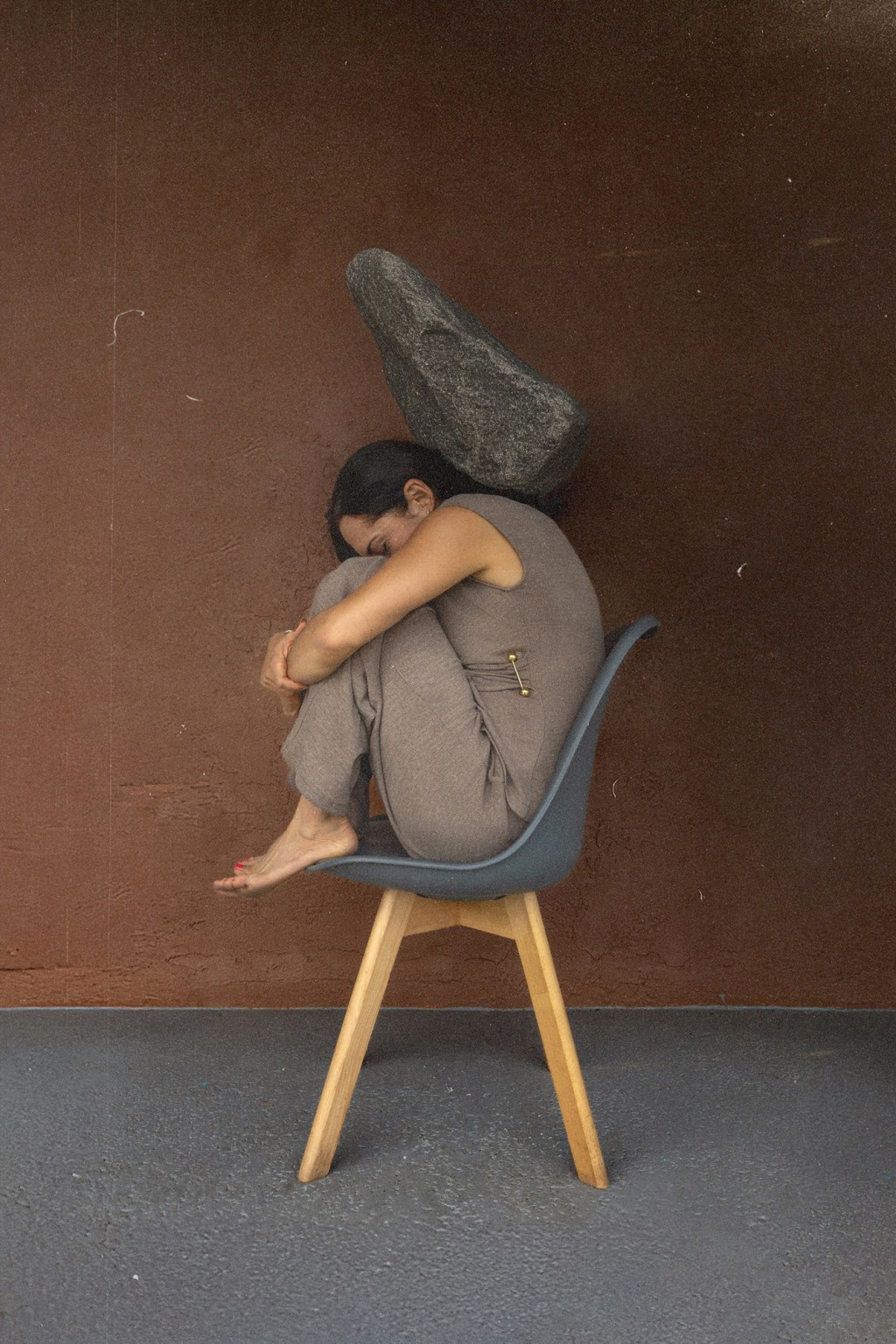
Author’s Note: I wrote this two days before Thanksgiving, still stuck in the freeze, still trying to trace the shape of what my body remembered. I didn’t edit it then. I didn’t have the distance. I’m sharing it now because the mess of it is part of the healing.
Bodies don’t separate lineage from the present moment.
I’ve been orbiting the same truth for hours, waiting for my body to let me look at it.
So I go back to what’s right in front of me—
this stuckness, this hours-long freeze where my mind keeps trying to force order onto a day that refuses to obey.
I know the list.
Pack. Prep. Clean. Load the car.
A rhythm I’ve done a hundred times, but tonight my hands won’t match the knowing.
My mind keeps rearranging steps, looking for the version that will finally make my body move.
It doesn’t.
We’re leaving in the morning for my mother-in-law’s.
Three days.
Family everywhere.
My daughter slipping out of the kitchen if I nudge her toward “helping.”
My body buzzing with the old script about what women should do, should know, should step into.
Which is absurd, because my mother-in-law has never once made me feel that.
Not once.
But the anxiety flared anyway, and for a while I couldn’t tell what it actually belonged to.
I thought maybe it was judgment—
that old prickle of being watched the way I was in my childhood home.
Then I thought maybe it was gender roles, the optics, the imagined commentary I’ve never heard in her house.
And then—
the old bruise bloomed.
Because my grandmother’s voice resurfaced—sideways and uninvited, woven into the edges of a day already too full.
Earlier this year she was on the phone complaining about the women on the farm—
how “they don’t help the men anymore,”
how “they don’t go out and do anything,”
how “it’s just a fright.”
The rhythm of those older circles—small towns, small orbits, the same echo-chamber conversations looping for decades.
I didn’t push back.
There was no point.
I validated the strangeness of watching the world shift away from the life she built.
She softened. We moved on.
Except I didn’t.
My body didn’t.
Because she wasn’t talking about the farm.
She was talking about worth.
About women proving it through labor.
About usefulness as identity.
About what she carried, what she expected my mom to carry, what she assumed I’d inherited.
And when she said “Where’s your helper?” that day in her kitchen—
joking, but not really—
my body knew what she meant.
Not “Where is he?”
But “Why aren’t you up?”
Why aren’t you doing more.
Why aren’t you showing me you value the way we’ve always done things.
Why aren’t you proving you are your mother’s daughter.
The pressure wasn’t new.
It didn’t surprise me.
I grew up reading nuance like weather.
I knew the call came from inside the house long before I ever had the language for it.
And then another memory surfaced—the one I never say out loud.
The night she said it was on me to take care of my mom,
as if I wasn’t already drowning in babies and exhaustion
and a mother who wouldn’t let herself be helped anyway.
Those were days I barely kept my own head above water.
And then, later, when everything in my world fell apart at the same time
and I went to her the way she’d always told me I could,
thinking “family takes care of family” meant something steady—
she let my toddlers and I sleep there one night
and told me that had to be enough.
Not unkind.
Not protective.
Just a door half-open, half-closed—
and the part of me that still believed in that promise collapsed inward behind it.
For a moment, I really thought that was enough.
But her world is all hard angles, and my mother-in-law’s house has never held that shape.
It came in pieces, while I was reminding myself I’ve hosted holidays for more than twenty years—
my family plus extended family, all of them in my house,
me in the kitchen, timing everything, pushing myself to make the day perfect
year after year until my body finally broke the pattern for me.
I know what it feels like to hold a holiday alone.
I’ve lived inside that rhythm so long it became its own muscle memory.
Maybe that’s why the next part cracked something open.
Because tomorrow,
we’re not walking into my house.
We’re walking into hers.
And she’s excited.
Genuinely.
And she’s not tense.
She’s not overwhelmed.
She’s not waiting for me to match her pace.
She’s… happy.
And my husband keeps reassuring me she loves when her house is full, that this is joy for her, that having us there is something she looks forward to.
My shoulders drop half an inch before the tension climbs back.
And even though her home has only ever been safe for me,
my body still doesn’t know what to do with ease that asks nothing in return.
Her space has never had the hard angles of the world I came from.
It feels lopsided—
like bringing all six of us into her house tilts something in the room I don’t know how to balance,
even though no one has ever asked me to keep score there.
And something in me folds at that—
because my kids lost their grandmother too early,
and my grandmother lost her daughter,
and I lost my mom before I ever understood the shape of that need—
and now somehow the only person left with even a trace of that warmth
is my husband’s mom.
I don’t have a place to put that.
It’s beautiful.
It’s crushing.
Part of me reaches for her without thinking.
Part of me grieves the reach itself.
All the losses stack at once,
and it’s hard to stay upright inside the weight of it.
Because trusting it means letting it matter.
And this year I’m walking in without the buffer I used to rely on—
no softness between me and the room.
Everything hits differently.
My mind knows she isn’t my grandmother.
My mind knows her care isn’t conditional.
My mind knows this house is safe.
But bodies don’t separate lineage from the present moment.
They just remember what vanished when you needed it most.
And so here I am—
tasks half-started,
heart half-braced,
sorting through all the things I swore tonight was about.
The kitchen.
The optics.
The gender roles.
The old conditioning.
The internal rules I was raised inside.
The farm comments.
The hosting muscle memory.
The freeze.
The pressure.
The planning.
All of it true.
None of it the core.
The core is quieter.
More tender.
My body doesn’t know what to do with being welcomed without being useful.
My body doesn’t know how to stand still in someone else’s generosity.
My body doesn’t know how to be cared for without preparing to earn my keep.
And I’m not trying to fix it tonight.
I’m not trying to be ready by morning.
I just want to walk in without leaving myself at the door.
Willing is enough.
 Echos of Insight
Leave a comment